

The Vulture Chronicles: The Cat Said Yes
Welcome back to the High Perch, where we look for the hidden patterns that help creativity and life flourish. Like vultures, we are interested in what sustains us when we learn to see differently, when we stop turning away from what’s already here.
Today I am joined by Deborah Kat. Deborah is a guide, educator, and truth teller whose work centers on embodiment, intimacy, and reclaiming our capacity for pleasure, presence, and choice. She has a rare ability to speak about desire and power without flattening them, inviting curiosity instead of correction and aliveness instead of performance. Deborah is also the host of the Better Sex Podcast, where she creates thoughtful, grounded conversations about intimacy, relationships, and what becomes possible when we stop outsourcing our knowing and start listening to ourselves.
Deborah and I are part of the same Year of Surrender cohort, and we recently traveled together to South Africa. It’s a place that doesn’t ask you to become smaller or quieter. It invites you into contact with the fullness of what’s available: beauty, appetite, sensation, contradiction, and joy, all at once. Watching Deborah move through that landscape and through conversation made this feel like the perfect moment to bring her into the High Perch.
This is a conversation about intimacy, yes, but also about vitality. About choosing to live awake. About what happens when we allow ourselves to want, to feel, and to be fully here.
Deborah, welcome.
Deborah:
Thank you for that beautiful reflection. I’m so thrilled to be here.
Barbara:
Of course. Can you give us a little background on you and what you’re creating?
Deborah:
I am the host of the Better Sex Podcast, and through that and through my coaching work with couples and singles, what I’m creating is more connection, more love, and more capacity to be human. I do that mostly by bringing people together in events, through couples coaching and one-on-one coaching, giving people the opportunity to practice being in relationship and to course correct. That’s not something we always have access to in our relationships. So I think I bring a little something special.
Barbara:
You do. Let’s get into our story arc. What’s something you never expected to get away with?
Deborah:
There are times when I’m about to say something and I think, am I really going to say this? And then I do. And when it lands, it can be transformative. The other thing is the homework I give my couples: be nice to each other, get naked together, give each other three compliments, including a flirty one. When they come back after doing it and tell me what happened, I think, did I really tell them to do that? For me, that’s part of the art of seduction. And the way I think about seduction is inviting someone to do what they already want to do. Giving them permission. So what I get away with, I’d say, is seducing my clients. And honestly, everybody.
Barbara:
I love that. You’re working right at the edge of things that are more challenging for people to talk about, and you’re putting a clear, warm invitation out there to come play. If your creative process had a spirit creature, what animal would it be?
Deborah:
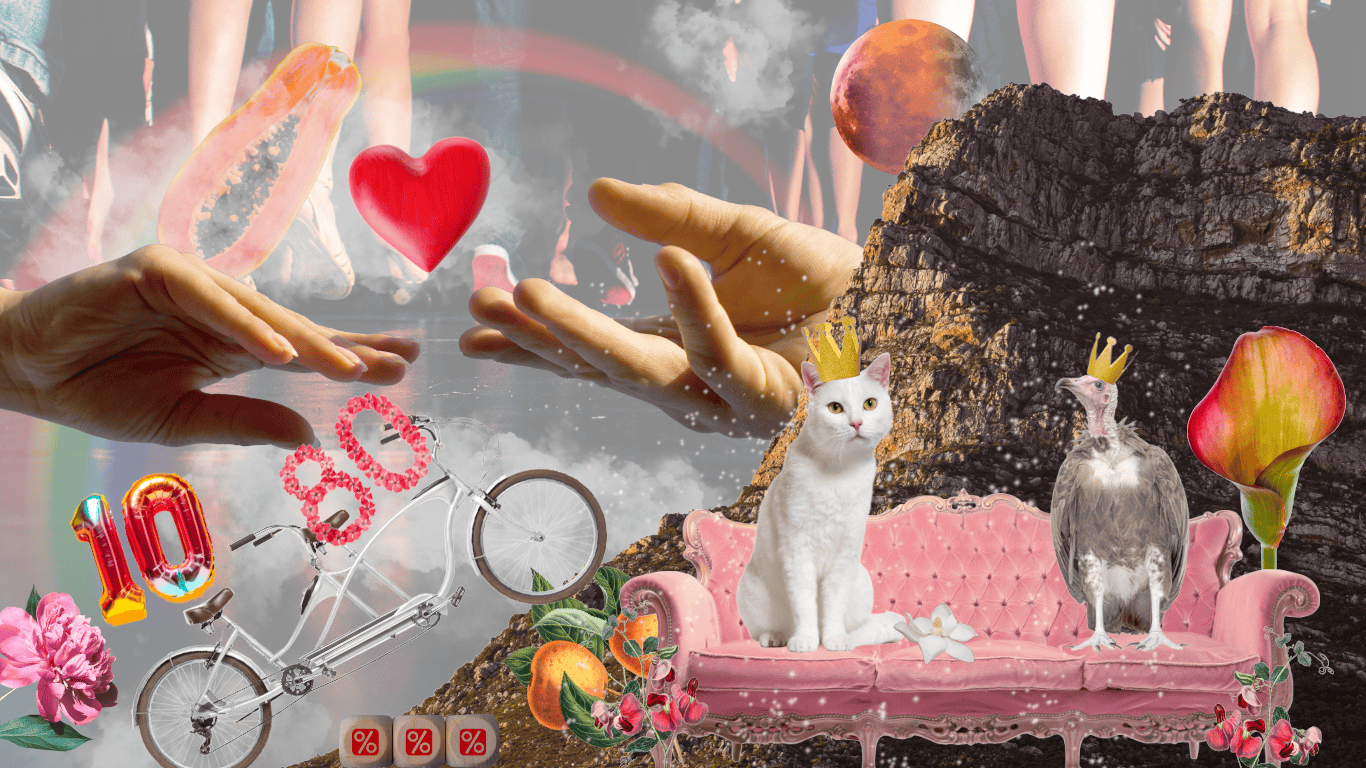
Absolutely a cat. I’ve been on a couple of vision quests where you’re supposed to meet your spirit animal, and mine has always been a white cat with a lot of attitude and a very comfy couch.
Barbara:
I love it. How does that feel aligned with your creative style?
Deborah:
There’s an element of sensuality to it. Cats invite you in, or they don’t. When I’m following a creative thread that’s in flow, I’m invited in. When that flow isn’t there, when something isn’t for me, there’s no invitation. One of the challenging things is figuring out: is this resistance, or is this a genuine lack of flow?
Barbara:
That’s so right. Cats are very clear with their nos. And they are absolutely in tune with their desires. We used to joke that one of my cats was the living embodiment of pure want. He’d do exactly what he liked, and he’d make his no very clear too. That’s what you’re describing with your creative process. What’s a piece of advice you love ignoring?
Deborah:
Oh, there is so much bad relationship advice out there. The mind reels. But the biggest thing I gleefully ignore is anyone who says there are rules when it comes to relationships. When it comes to how people love and connect, the only people they need to satisfy are the people involved. And sometimes from the outside it doesn’t look like it makes sense, but people stay until they’re done with whatever they need from that experience.
Barbara:
Yes. As someone who has been single and navigating the dating world, the strange advice out there regardless of your gender, the rules and milestones and when things are supposed to happen. You follow it and you lose touch with what you actually want, and what the other person wants, and whether those connect.
Deborah:
Exactly. My partner and I have been together 27 years and we’re getting married, so I’ve been researching weddings, and now my feed is full of advice. Some of it is practical, but there’s a lot about who you’re supposed to be, what it means to be a wife, what a marriage should look like. I’m getting a lot about letting your husband lead and learning to follow. I can see where that works for some relationships. In mine, we both lead and we both follow. I tend to be more of the idea person who then moves things to action. He tends to be the support once we’re in motion. If I waited for him to be the leader those books describe, not a lot would happen. Because, going back to the cats, he is very much a cat.
Barbara:
Your cat energy sees and recognizes his cat.
Deborah:
Exactly. Our feline forces have come together.
Barbara:
Can you tell me about a time when you thought a project was a disaster, but it turned into something great?
Deborah:
I feel like this is every project. My general process looks like this: I get super excited about something and I start moving in that direction. I get yes, yes, yes. And then there’s a moment in the middle where I think, why did I think this was a good idea? I sit in that for a moment. Then I remind myself we’ve been here before, enough times to know that I’m on the edge of something I haven’t done before. A place where I’m uncomfortable. My friends actually wait for it now. I’ll sign up for something and one of them will ask, is it still a good idea?
Barbara:
It’s so nice to be that well known by your people.
Deborah:
It is incredibly satisfying to be known. And it’s good that they know my process, because they can say, hey, you’re at that place. What do you want to do?
I was going to say, that’s where the crap advice can lead you wrong: oh, you’re getting a no, maybe you need to let this go. Versus: I’m getting a no because I’m uncomfortable and scared. This is edgy. And that’s exactly where creativity happens.
Barbara:
I was going to add that I think a lot of my readers and other creatives really recognize that place. You’ve been enthusiastic, and then you get to the part that’s asking you to grow into it. It’s uncomfortable and you think, what was I thinking? You’re in the messy middle.
Deborah:
My partner is an artist, and I watch him get to a point in a piece where, as he puts it, the conversation has come to a halt. His energy shifts for a while. And then I can tell when the conversation starts again, because something about him changes.
Barbara:
That’s brilliant. What’s something you’ve let die in a good way to make space for something better?
Deborah:
When I started coaching and working as an entrepreneur, I had a very specific idea of what it was going to look like. It never looked anything like that. What I had to let die was my attachment to that picture. The idea that people would work with me in a particular way, in a specific structure, a set number of months, a set package. I had to let all of that go. And as it turns out, there’s as much crap advice in the coaching and entrepreneurial world as there is in the relationship industry.
Barbara:
Along the lines of: do it exactly the way I did it and you’ll get exactly the same results. Completely false. What is the weirdest inspiration you’ve ever pulled into your work?
Deborah:
My background is both as a tantric educator and as a professional dom, so there’s a lot of ground to cover there.
Barbara:
There is. We love weird here, so you know.
Deborah:
I’m honestly not even sure how to answer that one. There’s a lot to choose from.
Barbara:
Take your time. We’ll go to the next question and come back if something surfaces. If you could scavenge a skill, talent, or idea from anyone, what would you grab?
Deborah:
Something from Brené Brown. She talks about a lot of brilliant things, but this one really shifted me: the idea that 50/50 in partnership is just wrong. The real idea is that you come in as an individual at a hundred percent. Some days you’re at 10. Some days you’re at 80. Being able to be with your partner wherever they are, and being able to say, hey, I’ve had a terrible day, I’m at 10. And your partner says, I’m at 80, I’ve got you. When you’re both at a low number, that’s when you really need to turn up the practices. Turn up the kindness. Be careful with each other.
My partner and I now check in this way. We ask, where are you on the scale? And it’s become a genuinely helpful conversation.
Barbara:
I love how you’ve clearly incorporated it into your own relationship and into how you talk about relationships with others. On the days when you’re both at 10, how do you survive that together instead of each expecting the other to make up the difference?
Deborah:
I was a total grump this morning. Didn’t sleep well. The world looked terrible. Once I told my partner where I was, he was able to shift a little. And that made me able to shift a little too.
Barbara:
Amazing how that works. Where do you feel most creative outside of work?
Deborah:
In my relationship, honestly. I take so much from work and think, I wonder what would happen if I applied this to the lab that is my actual relationship. But outside of that, on the dance floor.
Barbara:
Tell me about dancing.
Deborah:
I love dancing. I had a background in tap, ballet, and jazz as a kid. I did belly dance for a while. Right now I’m more of an ecstatic dancer. There aren’t a lot of rules. You can interact with someone or not. Movement is so important to my wellbeing, my mental health. I discovered ecstatic dance about 20 years ago. What’s interesting is how I’ve changed in the way I dance and the way I interact with the community. There are people I’ve been dancing with for 20 years who I may never have had a real conversation with. I know their body, their movement, their energy. I had a beautiful dance with someone recently who I know nothing about except how they show up on the floor.
If I’m feeling stuck, movement helps. Sometimes it’s turning on a song in my kitchen. Sometimes it’s going for a walk. But movement is key to everything.
Barbara:
I really relate to that. Dancing, singing, movement: these are so fundamental to being human. For people who haven’t tried something like ecstatic dance, they think they need training first, need to be good before they can do it. Little kids know better. They’re out there moving however they want. My wish for humanity is that we could all do that as needed.
Deborah:
Here’s the secret for ecstatic dance in particular: when your eyes are closed, no one can see you.
Barbara:
I love that. That’s great advice. Two more questions. If you could leave a feather or a small messy gift for future creators, what would you leave?
Deborah:
The idea that the more you know your own process, the more you recognize that “why the hell did I think this was a good idea” moment as a sign of gold. When that feeling comes up, you’re in expansion. You’re about to step into something bigger and something unknown. That would be my feather.
Barbara:
Terrific. Last one: what’s something delightfully unhinged about your creative process that you hope never changes?
Deborah:
I hope I never stop having fun. And I hope I never lose the joy I feel when I hit that place of awkward resistance, whether it’s mine or a client’s. There’s a certain feeling when we hit someone’s edge. Knowing that the breakthrough on the other side is so good that it’s worth going through the discomfort to get there.
Clients will sometimes have arguments in front of me that they would never have on their own, because there’s an element of permission in the room. Most of the time, when we get to the end of that argument and realize it wasn’t actually about the thing they were arguing about, that there’s a deeper piece not being heard or seen. When that gets opened up, and you see what’s actually possible there. I don’t want that to ever change.
Barbara:
That’s beautiful. Your willingness to not only hold space for people in that process, but to actively invite them into the sticky part. There’s clearly a lot of joy and aliveness for you in guiding people to that place. I love it. Thank you.
This conversation with Deborah feels less like a conclusion and more like an opening. An invitation into greater aliveness, deeper honesty, and a willingness to live into the plenty that’s already available when we stop editing ourselves.
If you’d like to explore Deborah’s work, you can find her at deborahkat.com. That’s Kat with a K. And for thoughtful conversations about intimacy, desire, and relational truth, find the Better Sex Podcast wherever you get your podcasts.
Until next time, stay sharp, stay weird. This is Barbara Evans, Brand Vulture. And this has been the Vulture Chronicles.
Deborah:
Thank you so much. This has been incredible.