

The Bridge: Doing Business Across Worlds
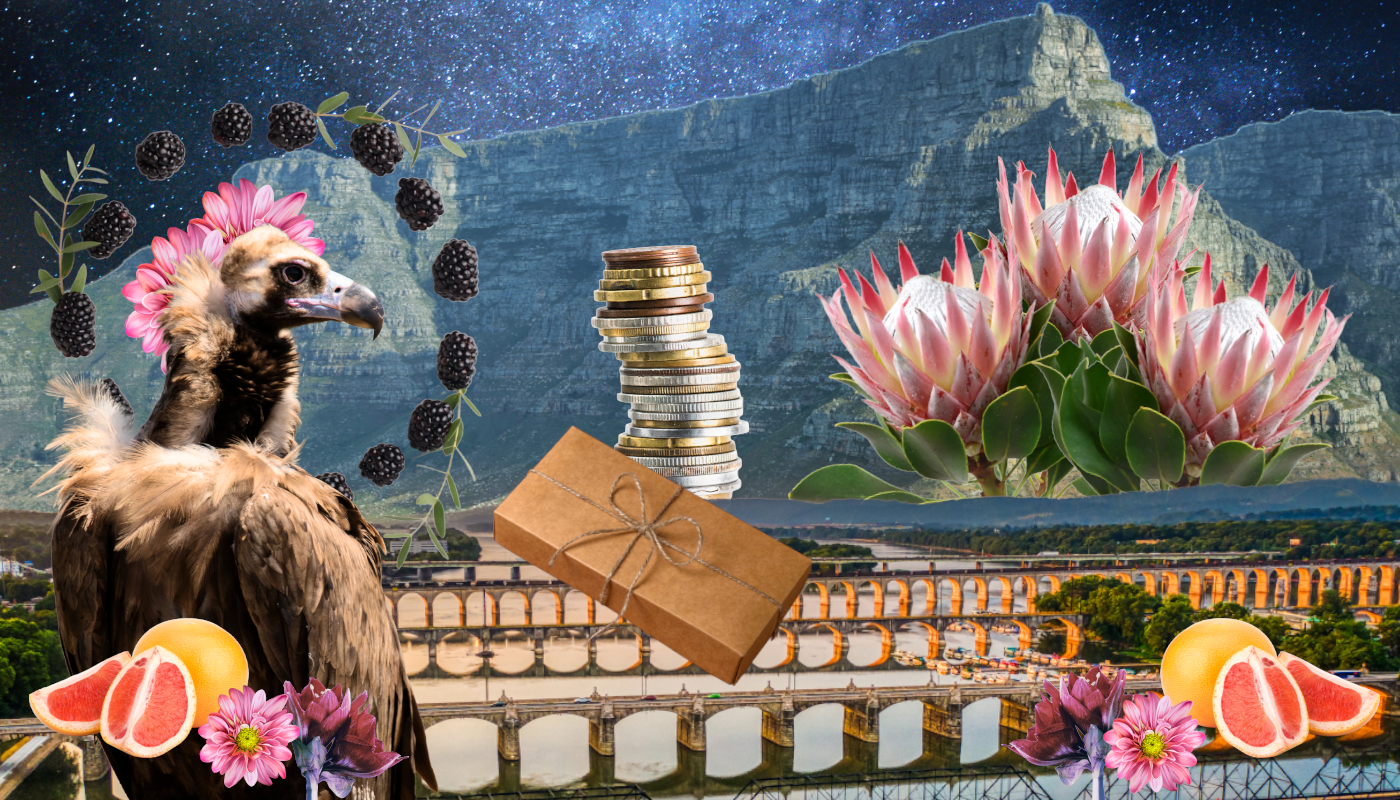
Part I — What Happens When Your Heart Lives in One Economy and Your Work Lives in Another
There are moments in business when something shifts, subtly at first, then all at once, and you realize you’re not just running a company.
You’re navigating two different worlds.
For me, that moment began in Cape Town.
The Inciting Incident: Being Woven Into a New Circle
On a retreat in Cape Town, I found myself woven into a new circle of women, mostly South African, with three of us from the U.S., whose work isn’t just “interesting” or “inspiring.”
It’s world-shifting.
These women are community builders, healers, creators, organizers, artists, and leaders whose work often exists outside traditional business structures. Their brilliance is incandescent. Their courage is bone-deep. And their relationship to money is tender and complex, shaped by South Africa’s history, its economy, and the realities of living in a system very different from mine.
In that circle, I felt both at home and suddenly very aware of the truth I had never fully named:
My heart and my business live in two very different ecosystems.
The Gift Economy and The Financially Resourced Economy
On one side is the work that lights me up from the inside: supporting global women whose visions feel like medicine for the world. Work that feels sacred and relational and deeply human.
On the other side is my client roster of U.S. companies: healthcare innovators, life sciences organizations, consulting firms, VC-backed companies, who operate in a capital-B Business economy where budgets exist, invoices are paid, and projects have timelines.
Here’s the tension:
The people whose work I most want to support are often the ones who can’t afford strategic branding or design.
Not because they don’t value it.
But because their currencies, economies, or access are fundamentally different from mine.
And the people who can afford my work often occupy systems and structures I’m not romantically aligned with but who still show up with integrity, values, and a desire to make things better.
Welcome to the bridge.
Living Between Two Worlds Isn’t Confusion. It’s Architecture.
For a long time, I thought this tension meant I was doing something wrong. That I hadn’t niched correctly. That I needed to pick a side.
But Cape Town changed my understanding.
What I realized (or maybe finally accepted) is that:
I’m not failing to choose a world.
I’m designed to serve as a bridge between them.
Here’s what that actually looks like:
World One: The Gift Economy (and the Mutual-Exchange Economy)
This is the realm where I sometimes work for reduced rates, sliding scales, or pure gift, but also where mutual exchange comes into play.
Sometimes the exchange is service for service, where what we each offer holds equal value even if the financial currencies don’t match.
Sometimes I let the person choose what they want to offer in return: art, healing work, guidance, community support, or skills I don’t have.
I’ve learned that these exchanges require:
- clarity (what is being exchanged and why)
- boundaries (so no one overgives or burns out)
- clear agreements (so the exchange is equitable, not vague)
- trust (because relationship is the real currency here)
This world isn’t ruled by invoices. It’s ruled by intention, collaboration, and the mutual belief that both of us walk away nourished.
And it feeds my soul, my creativity, my community, and my sense of belonging.
A Necessary Clarification: This Isn’t Charity or Saviorism
Before I go any further, I need to name this clearly.
The work I do in this space isn’t charity. It isn’t benevolence. And it is absolutely not me “reaching down” to help anyone.
The women I collaborate with, especially in global relationships, are extraordinary in their own right. They are healers, builders, organizers, visionaries. Their work is not less-than. Their capacity is not diminished. Their leadership is not in question.
The only difference between us is economic geography, not ability, intelligence, or worth.
Much of this relational, mutual-exchange work naturally unfolds in circles of women, because that’s where my deepest resonance tends to be. However, this approach extends to nonbinary folks and, at times, men as well. The heart of it is reciprocity, clarity, and right-sized exchange, not gender.
So when we work through sliding scales, mutual exchange, or service-for-service agreements, it’s not about me rescuing anyone. It’s about designing right-sized exchange that honors both of our realities, financial, cultural, and personal.
This isn’t charity.
It’s reciprocity, relationship, and respect of our individual sovereignty.
World Two: The Financially Resourced Economy
On the other side of my work is a very different ecosystem — one with budgets, scopes, and steady infrastructure.
These are the clients who give my business the scaffolding it needs to thrive:
Facet Life Sciences, ClaimsBridge, AideChoice, Hopewell Group, and Hands From The Heart, to name a few.
These organizations are mission-oriented in their own ways — advancing healthcare, supporting caregivers, improving patient journeys, or providing compassionate services in a system that doesn’t always make compassion easy.
With them, I get to show up in the full power of my strategic brain:
clear, steady, operational, creative, analytical, and grounded.
This work brings financial stability, long-term partnership, and the ability to plan for the future.
And because of them, I can sustainably support the women whose global work nourishes my heart.
This Isn’t a Compromise. It’s Integration
What I’ve learned is that different parts of my work nourish me in different ways.
My global, relational, mutual-exchange work feeds me creatively, emotionally, and spiritually.
It keeps me connected to purpose, community, and the kind of deep, human-centered collaboration that feels like home.
My long-term, financially resourced partnerships nourish me in equally important ways:
through stability, shared values, steady collaboration, and the privilege of working alongside leaders who are ethical, thoughtful, and deeply human in their approach to business.
This work challenges me intellectually, strengthens my strategic muscles, and provides the scaffolding that makes the rest possible.
Both ecosystems matter.
Both reflect my values.
Both support me, just in different currencies.
This isn’t a split life.
It’s a whole one.
Why I’m Sharing This Now
Because I know I’m not the only one.
Many of my clients and peers, especially women, ND creatives, healers, and founders, carry tenderness around money. They feel guilt for charging what their work is worth (ask me about my “vomit pricing” rule). They feel torn between who they want to help and who can afford them. They feel pressure to “pick a lane.”
Many women think they’re alone in this tension.
Maybe you’ve felt that too.
You’re not.
If your heart lives in one economy and your business lives in another…
you might actually be a bridge too.
And bridges aren’t small.
They’re essential.
What’s Coming Next
This post is the first in a new series:
The Bridge: Doing Business Across Worlds
Future pieces will explore:
- How to price ethically across cultures and currencies
- Navigating money with tenderness in global sisterhoods
- Mixing gift economy with sustainable business
- Why ND entrepreneurs often become natural bridges
- Doing meaningful work without replicating oppressive business structures
- What “enough” looks like in a new world economy
Because this work deserves language.
And so do the people living it.
Stay tuned for Part II.